
A Technical and Operational Guide for West, East, and Central African Commands
By Babasky Technologies | West Africa’s Pioneer UAV & Defence Systems Manufacturer
On 14 January 2024, a commercial quadcopter circled a military base in northern Mali. It dropped no bombs, but it transmitted live coordinates of troop positions. Hours later, a precision mortar attack devastated the base. This is the new reality: The drone does not need a warhead to be dangerous; it only needs a camera and a link to an adversary.
From the Sahel to the Mozambique Channel, non-state armed groups are using $2,200 commercial drones to bridge the gap against conventionally armed militaries. Counter-Unmanned Aircraft Systems (C-UAS) are no longer a luxury—they are a foundational capability gap that must be closed.
1. The African Drone Threat Landscape
The threat exists on a spectrum, from low-cost intelligence gathering to purpose-built armed systems.
Key Adversary Profiles
| Group | Region | Tactics |
| JNIM | Mali, Burkina Faso, Niger | Systematic overwatch of convoys and bases prior to IED/ambush attacks. |
| Boko Haram / ISWAP | Lake Chad Basin | ISR operations; documented attempts to weaponize commercial drone frames. |
| Al-Shabaab | Somalia, Kenya Border | High technical interest in reconnaissance and payload delivery. |
| Armed Groups (DRC) | Eastern DRC | Overflights of UN positions; layered threat in complex terrain. |
Threat Trajectory: The window to build C-UAS capability before weaponized drone attacks become routine is closing. Adversaries are actively pursuing one-way attack systems (suicide drones) through grey markets.
2. The Three Layers of Counter-Drone Defence
Effective C-UAS is a linear process. Missing one layer renders the entire system ineffective.
- Layer 1: Detection: Identifies if a UAV is in defended airspace. Range is critical; detection at 8km provides minutes of response time, whereas 800m provides only seconds.
- Layer 2: Classification: Distinguishes between a hostile drone, a bird, or a friendly aircraft using radar signatures, RF fingerprinting, and AI.
- Layer 3: Neutralisation: The “effect” that stops the mission. This ranges from “soft-kill” (jamming/spoofing) to “hard-kill” (kinetic destruction).
3. Detection Technologies Compared
No single sensor is perfect. Babasky recommends sensor fusion—combining multiple outputs to maximize accuracy.
| Technology | Strengths | Limitations | Best Application |
| Radar | Long range (10km+), all-weather. | Struggles with low altitude/clutter. | Wide-area base protection. |
| Radio Frequency (RF) | Detects control signals; identifies operator. | Fails against autonomous drones. | Urban environments. |
| Acoustic | Passive (no emissions). | Short range (<1km); noise interference. | Close-in perimeter warning. |
| Electro-Optical (EO/IR) | Visual confirmation; day/night. | Affected by weather; range-limited. | Target tracking/ID. |
4. Neutralisation: Jamming, Spoofing, and Kinetic Defeat
Radio Frequency (RF) Jamming
Disrupts the link between the drone and operator. Most drones enter a “failsafe” mode (land or return to home).
- Pros: Non-destructive, handles multiple drones.
- Cons: Can disrupt friendly GPS and comms if not precise.
GPS Spoofing
A sophisticated “takeover” that feeds false GPS coordinates to the drone.
- Pros: Allows the defender to “re-route” a drone carrying explosives to a safe landing zone for intelligence recovery.
Kinetic Defeat
Physical destruction via small arms, nets, or directed energy.
- Pros: Absolute certainty of neutralisation.
- Cons: High collateral risk from falling debris or secondary explosions.
5. The Babasky C-UAS System: Engineering for Africa
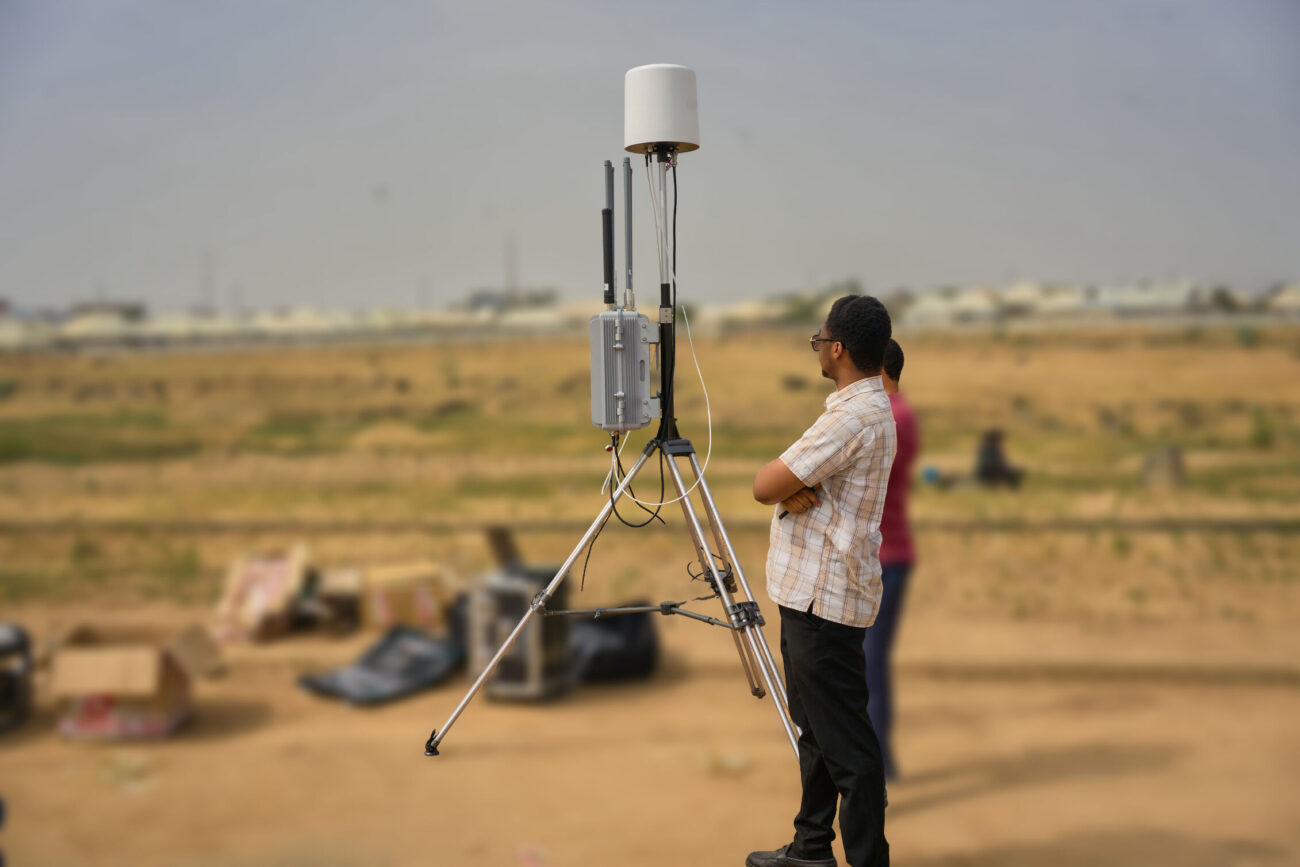
Designed and manufactured in Nigeria, the Babasky stationary C-UAS system is built for the specific environmental and procurement realities of the continent.
Technical Specifications
- Detection Range: Up to 8 kilometres (provides 6–8 minutes of warning).
- Simultaneous Tracking: 40+ contacts (resilience against saturation/swarm attacks).
- Neutralisation Radius: 3 kilometres via precision jamming and spoofing.
- Targeting: AI-assisted classification to reduce false alarms.
- Sovereignty: No foreign export restrictions or political conditions.
6. Operational Doctrine & Integration
Technology is only as effective as the doctrine behind it. Procurement must include a plan for:
- Command Integration: C-UAS data must feed directly into the central command post display to avoid information silos.
- Rules of Engagement (ROE): Establish clear thresholds. At what point is a drone classified as hostile? Who authorizes neutralisation?
- Maintenance: Babasky systems are hardened against the dust and heat of the Sahel. Localized technical support ensures high operational availability.
Conclusion: A Narrowing Window
The threat is documented and growing. Adversaries are learning from every engagement. African militaries must decide: invest now while the threat is primarily reconnaissance-based, or wait until the first major weaponized strike and respond in a state of crisis.
Babasky Technologies provides the sovereign choice: Tested for Africa, by Africa.
Request a C-UAS Capability Assessment
Babasky Technologies offers site-specific threat assessments for military commands and defence ministries.
